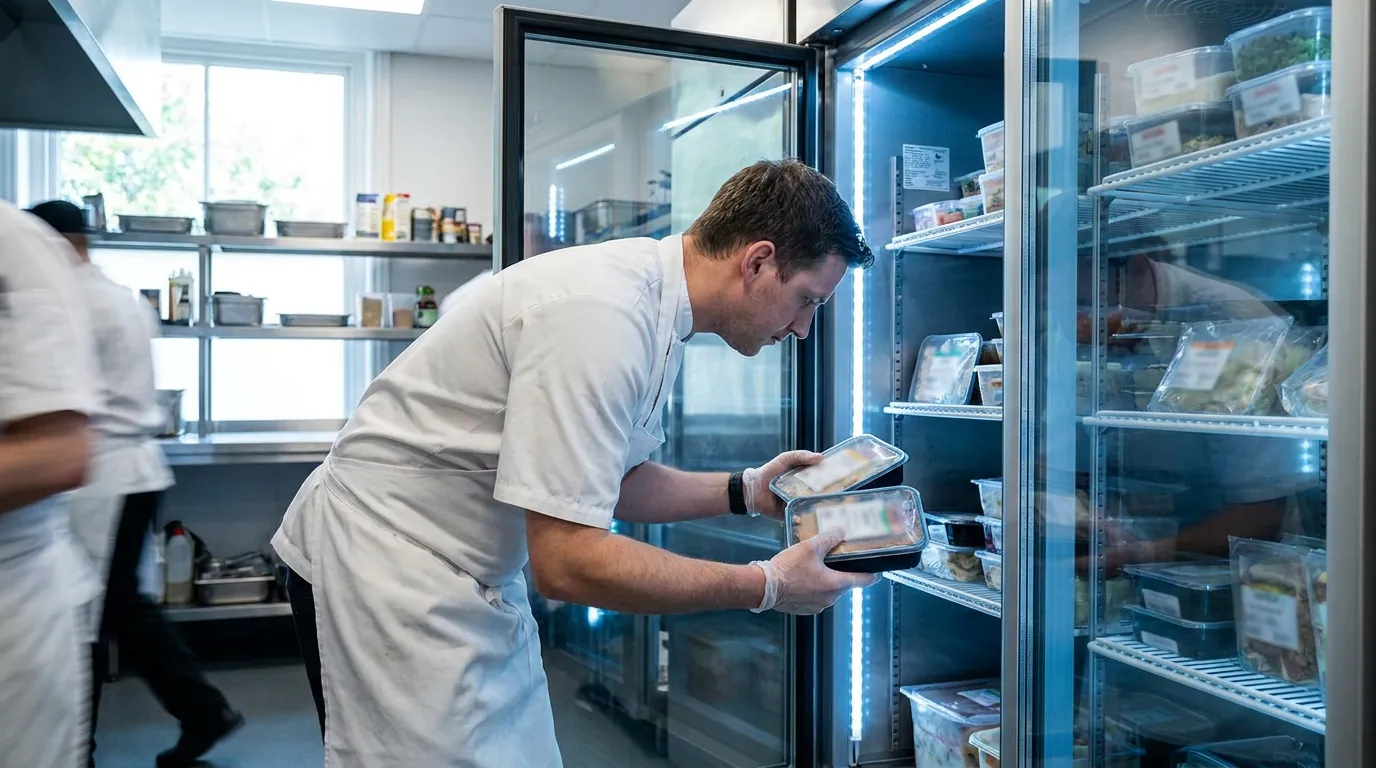
Food safety guide
Food Safety Culture: The UK Practitioner Guide (2026)
Food safety culture in the UK for 2026: the GFSI 5 dimensions, BRCGS Issue 9 clause 1.1.2, FHRS Confidence in Management link, 90-day build roadmap and the 10-question employee pulse.
1 May 2026

Every UK food safety prosecution has the same shape. Documented procedures existed. The team had been trained. The records were — mostly — filled in. And somewhere between the HACCP plan on the wall and the customer at the counter, the system broke. That gap between what’s written down and what actually happens at service time is what food safety culture is.
In 2026, culture has moved from soft concept to audit clause. The Global Food Safety Initiative’s five-dimension model is the reference definition used by the UK Food Standards Agency. BRCGS Issue 9 makes it a major non-conformity. The FHRS Confidence in Management score sits on a cultural judgement. Benedict’s Law, landing in English schools this September, is a cultural mandate with legal teeth.
This guide is the complete UK practitioner reference — the definitions that matter, where UK law stands in 2026, the five-element framework, how to assess your current state, and a 90-day build roadmap.
What food safety culture actually is — the definitions that count
GFSI — the reference definition
The Global Food Safety Initiative’s 2018 position paper “A Culture of Food Safety” is the canonical definition and the one the UK FSA has adopted in its own Board papers:
“The shared values, beliefs and norms that affect mindset and behaviour toward food safety in, across and throughout an organisation.”
An updated Version 2.0 was published at the GFSI Conference in Vancouver on 26 March 2026. The five-dimension architecture is preserved; a new dual-layered “Organisational Foundations + Manifested Practices” model is added on top.
The five GFSI dimensions
- Vision and mission — communicating why the business exists and translating that into expectations and messaging
- People — education, communication, rewards, recognition, accountability, teamwork, empowerment
- Consistency — alignment of priorities, resources, measurement, technology, documentation and systems
- Adaptability — capacity to respond to crises, scientific advances, and technological or regulatory change
- Hazard and risk awareness — foundational, science-based understanding of hazards across every level of the business
Codex 2020 — culture as a General Principle
The Codex General Principles of Food Hygiene (CXC 1-1969) were revised on 25 September 2020 to make food safety culture a general principle. Operative language:
“Fundamental to the successful functioning of any food hygiene system is the establishment and maintenance of a positive food safety culture acknowledging the importance of human behaviour in providing safe and suitable food.”
Codex lists five cultivating elements: management and personnel commitment; leadership; awareness; open communication including deviations and expectations; and sufficient resources.
Yiannas — “how they act when no one is watching”
Frank Yiannas (Walmart, then FDA Deputy Commissioner 2018-2023), Food Safety Culture (Springer, 2009):
“A food safety culture is how an organisation or group thinks about food safety, how they behave when it comes to food safety, or how they act when no one is watching.”
This is the sentence UK practitioners quote most. It captures why the gap exists between documented systems and actual outcomes.
Jespersen’s maturity model
Dr Lone Jespersen (Cultivate SA, chair of the GFSI 2018 technical working group and author of BSI PAS 320:2023) proposes a five-stage maturity model:
Doubt → React → Know → Predict → Internalise
Most UK operators operate between React and Know. The jump to Predict requires integrated leading indicators and active senior management engagement — which is precisely what BRCGS Issue 9 and the 2026 GFSI update are designed to formalise.
Just culture — the James Reason framework
James Reason’s five-subculture model (reporting, just, flexible, learning, informed) underpins modern safety thinking. A just culture distinguishes:
- Human error — console, fix the system
- At-risk behaviour — coach and support
- Reckless behaviour — discipline
The NHS England Just Culture Guide is the standard transferable UK tool. Applied in food safety, it makes near-miss reporting safe — which is the foundation of any serious cultural improvement programme.
Where UK law and audit schemes sit in 2026
Great Britain vs Northern Ireland — a legal split
This is the nuance most UK guides get wrong. Regulation (EC) 852/2004 was amended in the EU in 2021 (amending Regulation 2021/382) to require businesses to:
“establish, maintain and provide evidence of appropriate food safety culture.”
That amendment applies in Northern Ireland via the Windsor Framework. The retained Regulation (EC) 852/2004 in Great Britain was not amended, and the FSA has confirmed there are no plans to do so.
Practical consequence: if you operate across GB and NI, a single site in NI has an explicit statutory culture obligation that its GB sister sites do not. Multi-site operators need to design for the NI bar and apply it across the estate.
FSA stance — culture lives inside Confidence in Management
The FSA has run a dedicated food safety culture workstream since 2018 under the Regulating Our Future programme. The most explicit statement is in FSA Board paper 22-09-05 (September 2022):
“The current food hygiene intervention rating scheme does consider elements of food safety culture — in the confidence in management/control procedures part, for example, ‘the attitude of the present management towards hygiene and food safety’ is assessed.”
The 2023 FSA consultation on a Modernised Food Hygiene Delivery Model proposed formally embedding culture into CIM scoring. After mixed feedback on subjectivity concerns, the FSA shelved the decision matrix but committed to continuing to explore culture assessment “where appropriate”. A 2025 FHDM consultation (closed 19 May 2025) did not progress the matrix further.
Translation: culture is already in the CIM judgement informally. The FSA is holding back on codifying it further, but that doesn’t reduce its practical weight in inspections.
FHRS Confidence in Management — how culture bites
The FHRS Brand Standard governs CIM scoring. CIM is scored on a 0/5/10/20/30 scale — no 15 or 25. Lower is better: 0 means full confidence, 30 means no confidence.
A CIM of 20 caps the overall FHRS rating at 1. A CIM of 30 caps it at 0. The kitchen can be spotless and the critical limits perfectly met — if the inspector’s cultural judgement lands at 20, the rating is 1 regardless.
Inspectors interviewed in the FSA’s 2024 Value of FHRS research described CIM as a judgement of “whether managers are actually serious about food hygiene” — a cultural assessment in everything but name. See our Confidence in Management score guide for the full CIM scoring breakdown and our EHO inspection guide for the wider FHRS mechanics.
BRCGS Issue 9 clause 1.1.2 — the audit clause
BRCGS Global Standard for Food Safety Issue 9 (published August 2022, mandatory for audits from 1 February 2023) turns culture into an auditable clause. Clause 1.1.2 requires senior management to define and maintain a food safety and quality culture plan containing:
- Defined activities across every relevant section of the site
- Clear and open communication on product safety
- Training
- Employee feedback
- The behaviours required to maintain and improve product safety
- Performance measurement
- An action plan with timescales
- A review of effectiveness at least annually
Non-compliance is a major non-conformity — a commercially expensive finding that can block a major retailer listing.
BRCGS Culture Excellence is a separate optional module developed with Dr Joanne Taylor of Taylor Shannon International and Campden BRI. It organises assessment into four categories and 20 dimensions: People, Process, Purpose and Proactivity.
SQF and FSSC 22000 comparison
- SQF Food Safety Code Edition 9, clause 2.1.1.2 requires senior site management to lead and support a culture covering six minimum elements, including empowerment to act on food safety issues
- FSSC 22000 Version 6 clause 2.5.8 (mandatory from 1 April 2024) requires a documented food safety and quality culture plan with targets and timelines, reviewed in the management review cycle
| Element | BRCGS Issue 9 (1.1.2) | SQF Ed 9 (2.1.1.2) | FSSC 22000 V6 (2.5.8) |
|---|---|---|---|
| Documented plan | Required | Implied | Explicitly required |
| Targets and timelines | Required | Not explicit | Required |
| Annual review | Explicit | Via annual SQF system review | Via management review |
| Safety + quality scope | Both | Safety focus | Both |
| Employee feedback | Required | Required | Required |
BRCGS is the most prescriptive of the three. FSSC V6 mirrors BRCGS. SQF is behaviourally worded and the least prescriptive.
Benedict’s Law — a cultural mandate for English schools
Benedict’s Law is not yet law as of April 2026, but statutory guidance is expected to commence September 2026. The draft requires:
- Whole-school allergy awareness training for all staff
- Improved incident recording and lessons-learnt processes
- A comprehensive school medical conditions policy
- Individual Healthcare Plans
- Spare adrenaline auto-injectors
The Benedict Blythe Foundation’s own research (2024) found 70% of English schools did not have recommended allergy safeguards and 500,000 school days were lost to allergy-related illness in the past year.
This is effectively a cultural mandate for the English school estate — not just an anaphylaxis procedure. School catering operators should start preparing now. See our Benedict’s Law guide for the compliance breakdown.
Why culture matters — the numbers
The UK burden is £10.4 billion a year
The FSA’s Cost of Illness model puts the UK societal burden of foodborne disease at:
- ~2.4 million cases per year
- ~16,400 hospital admissions
- ~180 deaths
- Total cost: £10.4 billion in 2022 prices (updated from the £9.1bn 2018 figure)
UKHSA data shows both Campylobacter (70,352 cases in 2024, up 17.1%) and Salmonella (10,388, up 17.1%) hitting decade highs. Approximately 60% of foodborne illness cases remain unattributed to specific food.
Culture correlates with FHRS and commercial risk
- Approximately 78% of UK FHRS-rated businesses sit at 5 stars; around 97% are 3 or above; approximately 14,455 are rated 0, 1 or 2
- FSA research shows businesses rated 2 or below are roughly twice as likely to be linked to foodborne illness outbreaks
- 66% of consumers who know the scheme say a 4 is the lowest rating they would usually accept, or only a 5; just 3% would accept a 2 or below (FSA, Food and You 2: FHRS report wave 11)
- 28% have walked away from a business in the past year because it did not display its rating sticker, up from 15-18% in earlier survey rounds
Culture drives CIM. CIM caps the rating. The rating drives consumer choice and delivery platform access (see our delivery platform FHRS guide).
Culture correlates with incidents, retention and performance
Peer-reviewed literature (Foods 13:4078, 2024; Jespersen et al., Food Control 98, 2019) links stronger culture to:
- Lower absenteeism
- Higher engagement
- Fewer recalls and legal actions
- Improved financial performance
Nyarugwe et al. (2018) found proactive culture sites had fewer unsatisfactory microbiological results in dairy processors. Soon et al. (2020) found cross-contamination contributed to 28.6% and undeclared allergens to 40.5% of 2,932 global food incidents 2008-2018 — both culture-dependent failures.
The UK hospitality headwind — 52% turnover
UK hospitality has 52% annual staff turnover (CIPD analysis of ONS APS, 2022-23, against a UK average of 34%). Forty per cent of leavers move within hospitality; 12% leave the sector. Around 28.5% of UK zero-hour contracts are in hospitality and 50% of waiting and bar staff are aged 16-24.
Translation: documented competence alone is not enough. Culture has to survive constant onboarding, which is the single biggest operational test for UK SME food safety.
The paper compliance trap
This pattern sits behind most of the common reasons UK food safety systems fail — the systems themselves are fine, but culture doesn’t carry them through to service.
Campden BRI’s 9th Global Food Safety Training Survey (2026) found:
- ~95% of respondents say they understand what strong culture requires
- ~75% agreed “despite our training efforts, we still have employees not following established protocols on the floor”
That gap is the entire point. The business case for investing in culture isn’t “we don’t know what to do” — it’s “our system doesn’t translate to behaviour on the floor”.
The five elements of a strong UK food safety culture
This is the practitioner framework — GFSI’s five dimensions adapted to UK hospitality reality. Each element includes behavioural indicators, measurement, and a quick-win action.
1. Leadership and commitment
What it looks like day to day: the owner or General Manager opens service with a three-minute pre-shift huddle, probes fridges personally, signs off CCP checks, and is visible on the floor at lunch and dinner peaks — not just at open and close.
Measure:
- Walk-the-floor frequency (target: two per shift, logged)
- Percentage of pre-shift briefings completed
- Time-on-floor vs time-in-office ratio
- Staff agreement with “I see my manager checking food safety daily” (5-point Likert)
Quick win: scheduled 11am and 5pm kitchen walks with a printed checklist, one fridge temperature check signed personally by the GM, weekly five-minute Monday huddle.
2. Communication
Strong communication means near-misses get reported without punishment and whistleblowing routes are visible.
UK legal context: the Public Interest Disclosure Act 1998 protects staff who report food safety concerns. The FSA is itself a Prescribed Person for whistleblowing purposes. The FSA Food Crime Confidential hotline is 020 7276 8787.
Measure:
- Near-miss reports per month (a rising number in the first 90 days is a sign of trust, not failure)
- Percentage of staff who can name how to raise a concern
- Time to close out issues
Quick win: a “Speak Up” poster listing line manager, GM, FSA Food Crime Confidential and the Protect charity advice line (020 3117 2520). A standing daily huddle with a set agenda (deliveries, allergens today, one risk, questions).
3. Training and competence beyond Level 2
Level 2 for food handlers and Level 3 for supervisors (via CIEH, Highfield or RSPH) are the floor, not the ceiling. Typical UK costs: online Level 2 £12.50-£20; online Level 3 £20-£130; classroom Level 3 £400-£460.
Go beyond certificates:
- Observed competence sign-offs on probe calibration, handwashing and allergen change-over
- FSA’s free allergen e-learning at allergytraining.food.gov.uk
- Annual refreshers rather than the 3-year legal minimum
- The 14-allergen test — any handler can recite all 14 regulated allergens without prompting (celery, cereals containing gluten, crustaceans, eggs, fish, lupin, milk, molluscs, mustard, peanuts, sesame, soya, sulphur dioxide/sulphites, tree nuts). See our allergen matrix guide for the operational framework.
The Hannah Jacobs inquest (East London, August 2024) is the warning: the barista had completed online training but hadn’t used the under-till allergen guide. A certificate proves attendance, not competence.
4. Accountability and just culture
Adopt the NHS England Just Culture Guide decision tree before any disciplinary action. Review the last six months of incidents for instances where individual staff were blamed for what were actually systemic failures.
Measure:
- Ratio of systemic fixes to individual sanctions after incidents
- Psychological safety survey results
- Percentage of incidents that triggered a system change
Quick win: adopt the NHS decision tree. Audit the last six months of food safety incidents through the tree. Document any changes from “who” to “what”.
5. Continuous improvement
Use 5 Whys and simple A3 root-cause analysis on every non-trivial incident. Review digital dashboard KPIs weekly with the team — missed temperature checks, overdue cleans, open corrective actions.
Measure:
- Percentage of corrective actions closed within 7 days
- Repeat-incident rate
- Time to close an incident
Quick win: every incident report ends with 5 Whys. One “improvement of the month” poster in the pass.
How to assess your existing food safety culture
Published tools fit for UK use
Five tools cover the range from free to enterprise:
- Campden BRI / Taylor Shannon Culture Excellence — 4 categories, 20 dimensions, 80 data points via anonymous employee survey in 60+ languages, re-measurement at 12-18 months
- BSI PAS 320:2023 “Developing and sustaining a mature food safety culture” (authored by Jespersen) — the UK standards-body guidance
- FSA Greenstreet Berman Diagnostic Toolkit — free, UK-specific, 7 culture signals
- Cornell University FSCA and De Boeck et al.’s 28-indicator climate tool — open-access academic instruments
- SSAFE 15-question starter survey — free, 55 languages, under 10 minutes
Lagging vs leading indicators
Lagging (what already went wrong):
- FHRS rating and CIM sub-score
- Customer complaints
- Confirmed food safety incidents
- Product recalls
- External audit non-conformances
- EHO Hygiene Improvement or Prohibition notices
Leading (what predicts the next failure):
- Near-miss reports per FTE
- Training completion percentage
- Internal audit pass rate
- Temperature log completeness
- Glass and plastic register currency
- Allergen supplier specification currency
- Huddle attendance
- Dashboard KPI currency
The walk-the-floor test
Practical signals that predict a strong FHRS CIM score:
- Handwashing observed without prompting
- PPE worn correctly by every handler including kitchen porters
- Chefs calling out allergen decisions rather than hiding them
- Probes visibly in use and in date for calibration
- Labels current
- No pencil on temperature logs
- Staff able to answer “why do we do this”, not just “what do we do”
A 10-question employee pulse
Drawn from validated tools (GFSI, Campden, De Boeck, SSAFE). Deploy as an anonymous survey; baseline, re-measure at 90 days and quarterly.
- My manager is visibly focused on food safety during service.
- I can raise a food safety concern without fear of blame.
- I know who to tell if I see a near-miss or unsafe practice.
- Training I receive translates to how I actually work on shift.
- I can name all 14 allergens and know what each means for our menu.
- When something goes wrong, we investigate the system, not just the person.
- Our digital or paper records match what actually happened on the shift.
- I have the equipment and time I need to do food safety tasks properly.
- I know the last time we reviewed a near-miss as a team.
- I would eat here.
Question 10 is the single most revealing. A staff member who wouldn’t eat at their own workplace is telling you everything.
The 90-day build roadmap
Culture cannot be switched on. But the first 90 days produce measurable movement in leading indicators and set the foundation for 6-12 month gains in lagging indicators.
Week 1 — baseline and commit
- Document senior management sign-off on a culture plan (BRCGS 1.1.2 style, even if you’re not BRCGS-certified)
- Deploy the 10-question pulse as a baseline
- Audit FHRS history and CIM sub-score if accessible
- Adopt the NHS Just Culture decision tree
- Put the “Speak Up” poster in the pass
Month 1 — establish rhythm
- Daily pre-shift huddle with a set agenda (5 minutes, max)
- Two scheduled GM/owner floor walks per shift
- One fridge temperature check signed personally by the GM per shift
- Weekly 15-minute team food safety review
- Implement 5 Whys on every incident report
- Start a near-miss log — celebrate the first report
Quarter 1 — embed and measure
- Allergen spot quiz every Monday (name the 14)
- Competency sign-offs on handwashing, probe calibration, allergen change-over for every handler
- Monthly leading-indicator dashboard review
- First follow-up pulse at 90 days
- Review the quarter’s incidents against the NHS Just Culture tree — document any re-categorisations
- External audit or FSA Greenstreet Berman Diagnostic Toolkit deployment
Multi-site vs single site
For single-site operators, this roadmap is personally led by the owner or GM. The cultural change is a managerial behaviour change.
For multi-site operators, the additional steps are: a central culture plan with site-level implementation plans, cross-site pulse data comparison, site-manager coaching on the five elements, and a standing senior leadership agenda item on culture metrics.
Expect two to three years to move one Jespersen maturity stage in a multi-site operation. The early wins are in Month 1-3; the transformational wins are in Year 2.
The role of digital food safety management systems
A digital FSMS solves the single biggest cultural weakness in UK food businesses: records that don’t match reality.
- Point-of-task capture — records created when the task is done, not back-filled the morning of an inspection
- User attribution — every entry shows who did what, when
- Real-time dashboards — leading-indicator visibility for management
- Escalation triggers — missed tasks surface before they become non-compliance
- Allergen matrix linked to recipes — supplier reformulations flow through automatically
The argument is not that digital replaces culture. It’s that digital makes culture evidenceable. A strong-culture site running paper records can pass an inspection and still fail a prosecution because the records don’t prove what happened. A digital trail closes that gap.
Prevention of Future Deaths — where culture is implicit but not always named
Coroners’ Prevention of Future Deaths reports rarely use the phrase “food safety culture failure”, but several implicate it:
- Celia Marsh PFD (2022-0379, Senior Coroner Maria Voisin) — vegan labelling integrity and supply-chain testing failure. The underlying issue is cultural: what gets checked versus what gets assumed.
- Benedict Blythe PFD (2025-0595, Area Coroner Elizabeth Gray) — focused narrowly on pathology retention, though the family publicly criticised the report for not addressing the school’s systemic failings.
A 2025 KCL study found only around two anaphylaxis PFDs per year in the UK, with 40% of organisations failing the 56-day response deadline and 52% taking no action. The PFD system is not yet an effective cultural-change lever — which makes operator-led culture change even more important.
The operator takeaway
In 2026, UK food safety culture is:
- A GFSI-defined, Codex-embedded general principle
- An auditable BRCGS Issue 9 clause (major non-conformity for non-compliance)
- Implicitly inside the FHRS Confidence in Management score that caps your overall rating
- Statutory in Northern Ireland (via the Windsor Framework) but not in Great Britain
- A cultural mandate for English schools from September 2026 via Benedict’s Law
And it’s the single best predictor of whether your documented system actually works when no one is watching.
The five elements — leadership, communication, training, accountability, continuous improvement — are well-established. The 90-day roadmap produces measurable movement. The tools to assess and measure exist. What’s missing, in most UK food businesses, is the senior-management commitment to actually deploy them.
Where Forkto fits
Every prosecution, every failed audit, every dropped FHRS rating shares a pattern: the records didn’t match what actually happened, because the culture didn’t support creating records at the point of task. Clipboards get filled in at the end of the shift. Cleaning schedules get signed before the cleaning happens. Temperature logs get copy-pasted from last week.
Forkto’s digital food safety platform is built to close exactly that evidential gap. Records captured on a phone at the moment of action. Every entry time-stamped and attributed. Dashboard KPIs visible to management in real time. Near-misses logged with one tap rather than ignored. An audit trail that matches reality, not a version of reality prepared for an EHO visit.
If you’d like to see what that looks like in a UK hospitality operation, start a free trial or browse our free downloadable checklists — no email required.
Last updated 1 May 2026. This guide reflects UK regulatory and audit-scheme positions at May 2026 including GFSI Position Paper Version 2.0 (March 2026), BRCGS Global Standard for Food Safety Issue 9, Codex CXC 1-1969 (2020 revision), SQF Edition 9, FSSC 22000 Version 6 (April 2024), FSA Food Standards Agency Board papers, and the FHRS Brand Standard. The GB/NI regulatory divergence on Regulation (EC) 852/2004 amendment 2021/382 is confirmed in FSA Board paper 22-09-05 and the most recent FSA published guidance.
Related Forkto software
Frequently asked questions
What is food safety culture?
The Global Food Safety Initiative defines food safety culture as the shared values, beliefs and norms that affect mindset and behaviour toward food safety in, across and throughout an organisation. The UK Food Standards Agency has adopted this definition. Codex Alimentarius added food safety culture as a General Principle of Food Hygiene in September 2020.
Is food safety culture a legal requirement in the UK?
Not explicitly in Great Britain. Regulation (EC) 852/2004 was amended in the EU in 2021 to require businesses to 'establish, maintain and provide evidence of appropriate food safety culture'. That amendment applies in Northern Ireland via the Windsor Framework, but the retained version in Great Britain was not amended. However, culture sits inside the FHRS Confidence in Management judgement and BRCGS Issue 9 clause 1.1.2 makes it a major-non-conformity audit item for any business seeking BRCGS certification.
What are the 5 elements of food safety culture?
The GFSI 2018 position paper sets out five dimensions: vision and mission; people (education, communication, rewards, accountability); consistency (priorities, resources, systems); adaptability (responsiveness to change); and hazard and risk awareness. Updated Version 2.0 was published at the GFSI Conference in March 2026, preserving the five-dimension architecture.
How does food safety culture affect my FHRS rating?
Culture is assessed inside the Confidence in Management (CIM) element of FHRS scoring. CIM is scored 0/5/10/20/30 — no 15 or 25 — and a CIM of 20 or 30 caps the overall rating regardless of how clean the kitchen is on the day. EHOs describe CIM as a judgement on whether managers are actually serious about food hygiene, which is a cultural judgement in all but name.
What is BRCGS Issue 9 clause 1.1.2?
Clause 1.1.2 of the BRCGS Global Standard for Food Safety Issue 9 requires senior management to define and maintain a food safety and quality culture plan with defined activities, clear communication, training, employee feedback, required behaviours, performance measurement, an action plan with timescales, and an annual review of effectiveness. Non-compliance is a major non-conformity at audit. In force for audits since 1 February 2023.
What's the difference between food safety culture and food safety management?
Food safety management is the system — HACCP plans, procedures, records, audits. Food safety culture is the mindset and behaviour that determines whether people actually follow the system, especially when no one is watching. Frank Yiannas' definition captures it: food safety culture is how an organisation acts when no one is watching. A strong FSMS with weak culture produces paper compliance that fails at the service counter.
How do you measure food safety culture?
Use both lagging and leading indicators. Lagging: FHRS rating, CIM sub-score, customer complaints, food safety incidents, recall history, EHO notices, external audit non-conformances. Leading: near-miss reports per employee, training completion, internal audit pass rate, record completeness, huddle attendance. UK-specific tools include the FSA Greenstreet Berman Diagnostic Toolkit (free), BSI PAS 320:2023, BRCGS Culture Excellence via Campden BRI, and the SSAFE 15-question starter survey.
How long does it take to change a food safety culture?
Measurable improvement in leading indicators (near-miss reports, huddle attendance, record completeness) typically appears within 90 days. Lagging indicators (FHRS rating, incident rate) follow in 6 to 12 months. Lone Jespersen's five-stage maturity model — Doubt, React, Know, Predict, Internalise — suggests two to three years to move one maturity stage in a multi-site operation.
Who is responsible for food safety culture in a UK food business?
The food business operator carries ultimate legal responsibility. Day-to-day ownership should sit with senior management — the owner or General Manager in a single-site, the Head of Food Safety or QA in a multi-site business. BRCGS Issue 9 explicitly requires senior management sign-off on the culture plan. Tesco v Nattrass is the principle: due diligence by an employee is insufficient if the directing mind of the company was not also diligent.
What is just culture in food safety?
Just culture distinguishes three types of behaviour: human error (console and fix the system), at-risk behaviour (coach and support), and reckless behaviour (discipline). The NHS England Just Culture Guide is the standard transferable UK framework. Applied in food safety, just culture makes near-miss reporting safe — staff tell you when something went wrong so the system can be fixed, rather than hiding issues until they become incidents.
Safe hands, clear records
Stop running food safety on paper
Forkto turns daily checks, temperature logs, HACCP and audits into a few taps on a phone. Your team stays consistent and you're always ready for the EHO.
14-day free trial · No card required